
Sometimes known as compression strength parallel to the grain, this is a measurement of the wood’s maximum crushing strength when weight is applied to the ends of the wood (compression is parallel to the grain).

This number is a good indicator of the wood’s strength in applications such as deck posts, chair legs, or other circumstances where the load being applied is parallel rather than perpendicular to the grain.
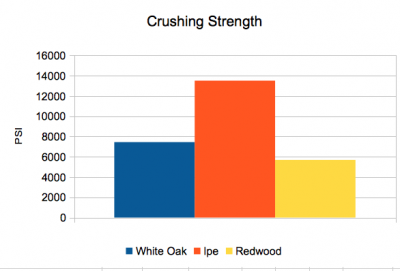
In practical terms, the number itself isn’t all that meaningful, but it becomes useful to use in comparison with other woods. For instance, Ipe is known to have excellent strength properties among imported species, and has a crushing strength of 13,510 lbf/in2 (93.1 MPa). In comparison, White Oak is a well-known wood used in cabinetry and furniture, and has a crushing strength of 7,440 lbf/in2 (51.3 MPa), and Redwood is commonly used for decking, and has a crushing strength of 5,690 lbf/in2 (39.2 MPa).
Get the hard copy
 If you’re interested in getting all that makes The Wood Database unique distilled into a single, real-world resource, there’s the book that’s based on the website—the Amazon.com best-seller, WOOD! Identifying and Using Hundreds of Woods Worldwide. It contains many of the most popular articles found on this website, as well as hundreds of wood profiles—laid out with the same clarity and convenience of the website—packaged in a shop-friendly hardcover book.
I would like to know what specis has the best weight to crushing strength ratio?
Sorting through the data, it appears that Licaria canella (Kaneelhart) has the best crushing strength to weight ratio. (Although bamboo also ranks very high, but I tend to discount this as bamboo has so much variation between species, and the data is very patchwork and can be taken from such a wide variety of species that it may be that we end up linking the strength of one species with the weight of another, etc.)
So much for Egyptians using wooden sleighs to move stone. The weight of the Unfinished Obelisk is over 20 million pounds. Wood vaporizes underneath such forces and moments.
They used the hydraulic force of water.
2.4 million pounds, not 20 million. It weighs a little under 1200 tons. It’s made of red granite. I don’t know what density was used to estimate the weight, but 170 lbs/cubic foot is reasonable. That would give somewhere in the neighborhood of 13,700 cubic feet. It’s 137 feet tall, so the average cross section (thicker at the base, thinner near the tip) would be about 10 feet by 10 feet. That means each square foot of decking that you would need to support the thing would have to support a 10-foot column of stone. That would weigh 1700 pounds.… Read more »
I was looking for other issues that led my to the crushing/compression strength(parallel) but landing here did get me the link to :Mechanical Properties of Wood
David E. Kretschmann, Research General Engineer
I have a lot to research for what I want to find out which is requirement on many fronts. I know you are busy person but I’d like to run an idea by if you have the time on the combination of aspects/specifications I’d like to find in a wood to make a staff type combat weapon.
The overriding consideration would be the impact bending strength, determined by dropping a weight on a test specimen supported at each end like a beam. That’s not listed in the wood database but is listed in “Mechanical Properties of Wood”, available online.
The only other consideration would be surface hardness (Janka), but woods with high impact strength are generally hard. The true hickories are the best of all. A harder wood, like a purpleheart, will dent hickory, but repeated clashes will eventually break the harder staff while the dented hickory keeps going and going, like the Energizer Bunny.
Where can I find numbers for wood strength in tension parallel to the grain? Crushing strength is about compression, and elasticity is about bending perpendicular to the grain, so not really what I want either. I’m building a guitar and want to make a top from Sitka Spruce and another top from carbon fiber sheet, and compare them. I know Sitka Spruce tops on guitars are typicaly 1/8″ (3.2mm) with additional bracing. Elastic (flexure) modulus of Sitka Spruce is 11 GPa. But you don’t list the tensile strength of Sitka Spruce. I need to figure out an equivalent thickness for… Read more »
Can’t address all your questions, but the USDA wood handbook has more in-depth information on select species of woods, sitka spruce being one of them. https://www.fpl.fs.fed.us/documnts/fplgtr/fplgtr190/chapter_05.pdf
Hello Eric, I would like to delve further into this, as per Gregory’s enquiry ut for entirely different reason…. I have started making laminated longbows and looking into what woods are best suited. I have read your piece on this subject and fascinated by the “Bow Index” you produce relating MoR with MoE. However, as pertinent as this is it is not the whole story. The inner laminate, facing the archer (belly), is subject to compression. The centre laminate (spine) merely flexes but the outer laminate (back) is under tension. Woods ideally suited to spine include Purpleheart from S. America… Read more »
You’re right about the USDA links, they recently changed their link structure so I’ve had to update all the links, but overlooked links in the comments. It should be updated to work now.
Be aware that the speed of sound along and perpendicular to the grain both affect the performance of a guitar top. So strength is only a small part of the story.
Fot example, this is the reason that the grain of the wood runs along the long dimension of the guitar.
Equivalent CFRP is not a simple matter. Let me refer you to this video, that shows one high end manufacturer’s process. I think the part you want starts at about 4:45, where you can see the templates. He says it is 2 to 8 layers per top, but often many of the layers do not cover the whole top and merely provide reinforcement to an area, much like bracing. Designing a layup would be a little bit like designing the bracing for a conventional top. The material is all 3k 2×2 twill. Later in the video, he shows a fretboard… Read more »